The Root System of Hebrew Words
Hebrew words are derived out of the many Hebrew root words (parent, child and adopted roots), as demonstrated in the graphic below.
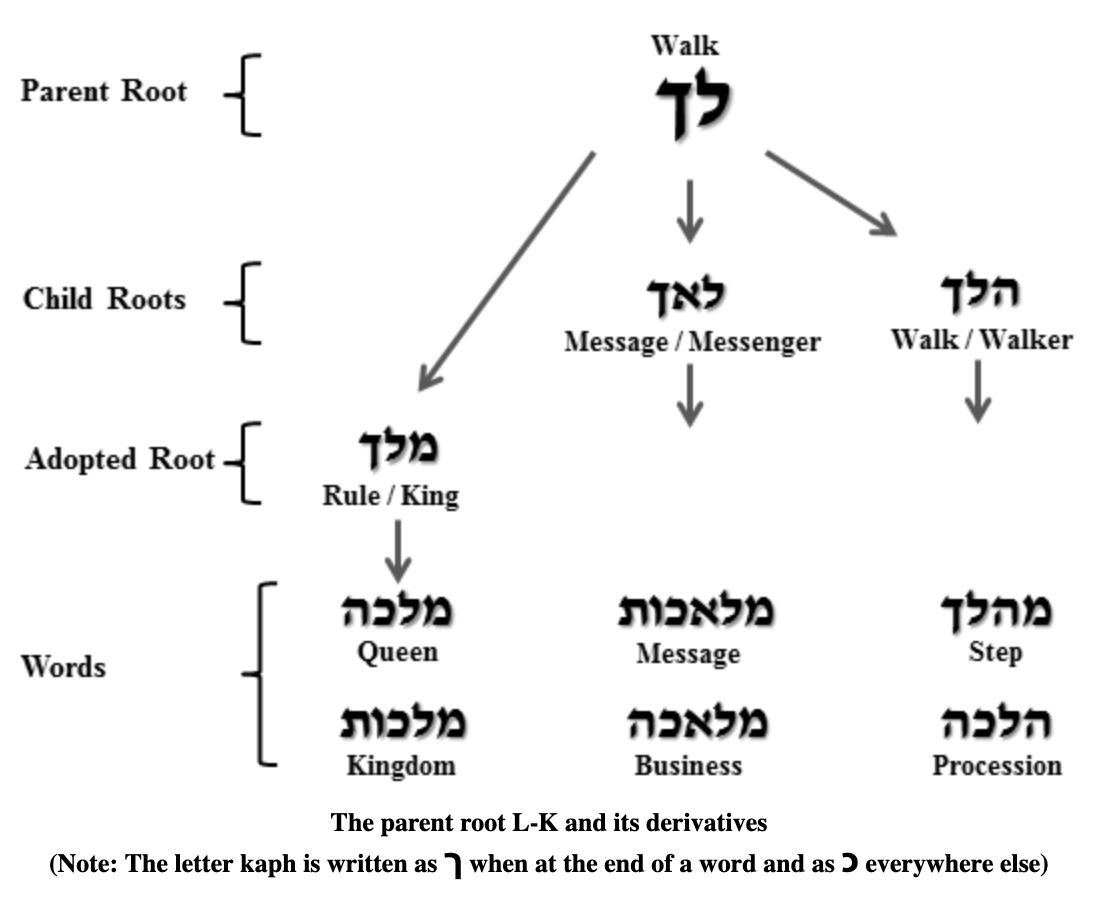
Derived from the parent root לך (LK) are two child roots, הלך (HLK) and לאך (LAK), and one adopted root, מלך (MLK). The child הלך is formed by adding the letter ה (H) to the beginning of the parent, the child לאך by adding the letter א (A) in the middle and the adopted by adding the letter מ (M) to the beginning.
Hebrew roots can be used as a verb or a noun. In English, a verb is a word of "action" and a noun is a "person, place or thing," something void of action. In Hebrew, a verb is a word for the "action" of "a persona, place or thing," and a noun is a word for "a person, place or thing" in "action." As an example, the root מלך (MLK) can mean "the rule of the king" as a verb, or "the king who rules" as a verb (Strong's #4427), or "the king who rules" as a noun (Strong's #4428).
Other words are derived out of the child and parent roots by adding specific letters to the roots. As an example, the noun מלכה (MLKH, Strong's #4436) is formed by adding the letter ה (H) to the end of the root and means "the female king who rules" or "queen," and the noun מלכות (MLKUT, Strong's #4438) is formed by adding the letters ות (UT) to the end of the root and means "the region ruled by the king" or "kingdom."
Once we understand how to properly interpret and define Hebrew words based on their relationships to their roots and the culture in which the words were used, we can then properly interpret Biblical passages from a Hebraic perspective.
And showing mercy unto thousands of them that love me and keep my commandments. (Exodus 20:6)
Our normal understanding of the word "keep" within this verse is to "obey," however this is not the case. The Hebrew verb used here is שמר (shamar, Strong's #8104), which literally means "to guard" or "to protect."
They will turn to other gods and serve them, and despise me and break my covenant. (Deuteronomy 31:20)
Similarly, our normal understanding of "break" within this verse is to "disobey," but again this is not the case. The Hebrew verb here is פרר (parar, Strong's #6565) and means "to trample underfoot."
The "keeping" or "breaking" of the commandments of God is not about obedience and disobedience; it is about one's attitude toward them. Will we guard and protect them as we would our family, or will we throw them on the ground and trample them as we would garbage?