How Culture and Thought Shape the Meaning of Scripture
Bible translators will often ignore the grammar and vocabulary of the original language in preference to something that is more complimentary to the way you think. For instance, would it surprise you to learn that they have translated the Hebrew words nephesh, meaning "soul," and kil'yah, meaning "kidneys," with the word "heart?" If you would like to learn more, read on.
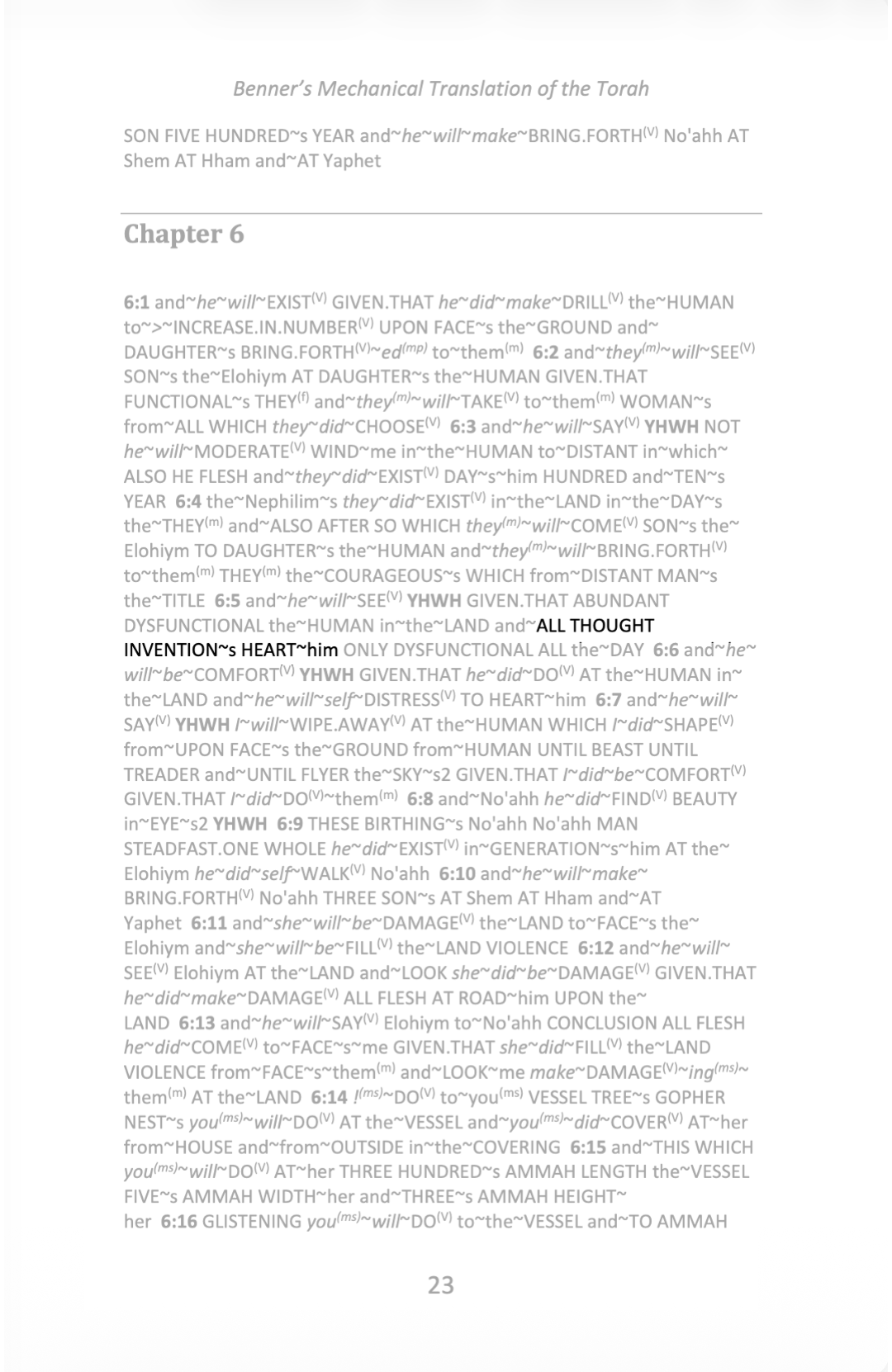
…every imagination of the thoughts of his heart… (Genesis 6:5, KJV)
Do you notice anything “odd” in this phrase? This, and other similar verses, helped me to understand that the people of the Bible think, no pun intended, differently than we do. While we associate the “heart” with emotion, the Hebrew people associated it with thought.
Let’s take a look at this phrase from my translation, Benner’s Mechanical Translation of the Torah.

This translation is designed to allow the reader to view the original Hebrew of the Bible through the English language. Every word, prefix and suffix are translated exactly the same way every time and the text is in the same order as it appears in the Hebrew.
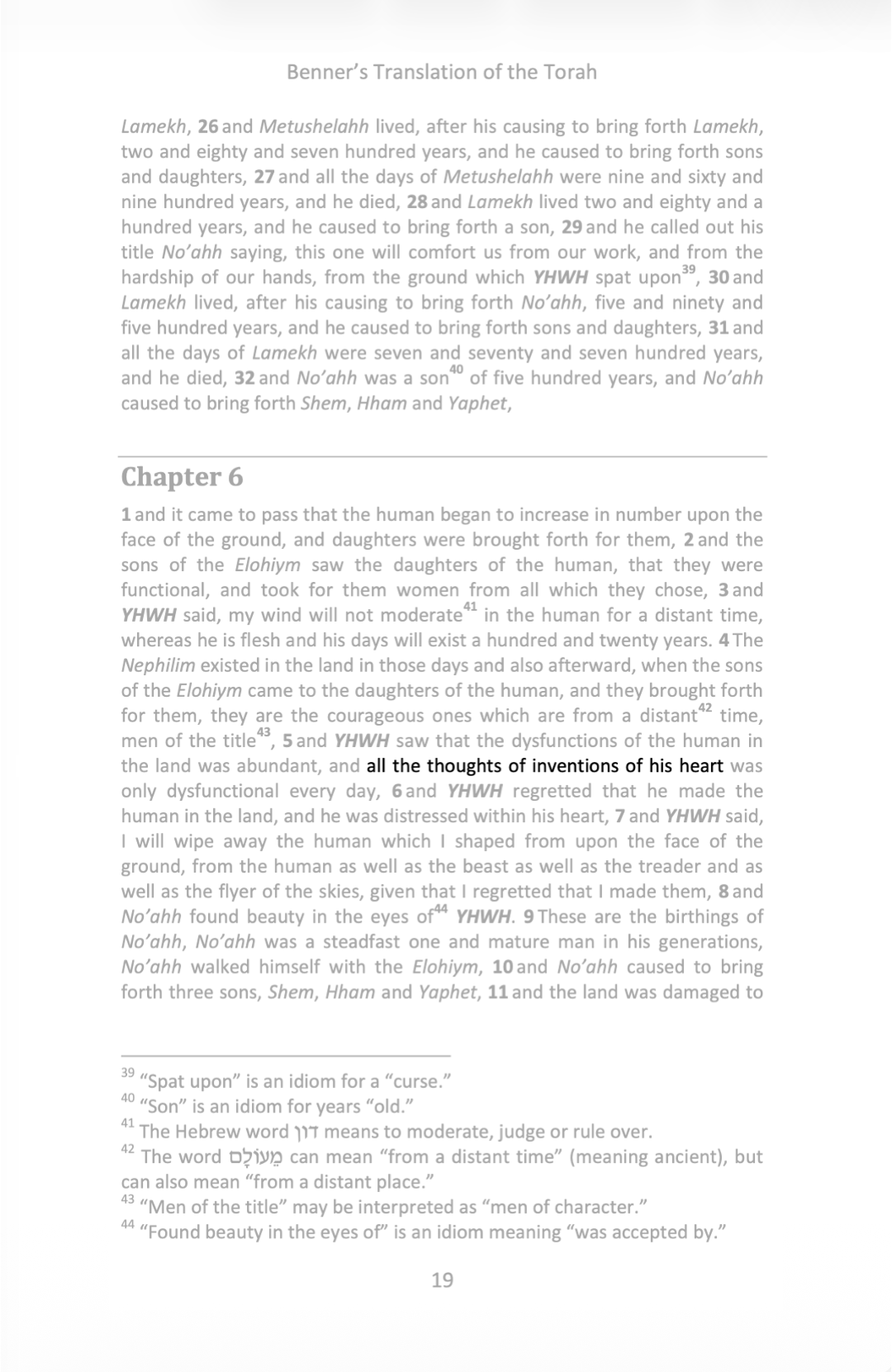
Because this translation can be difficult to read, I also have my revised translation, Benner’s Translation of the Torah, which transforms the mechanical translation into something readable and understandable to the average English reader. Here is my translation for this phrase.

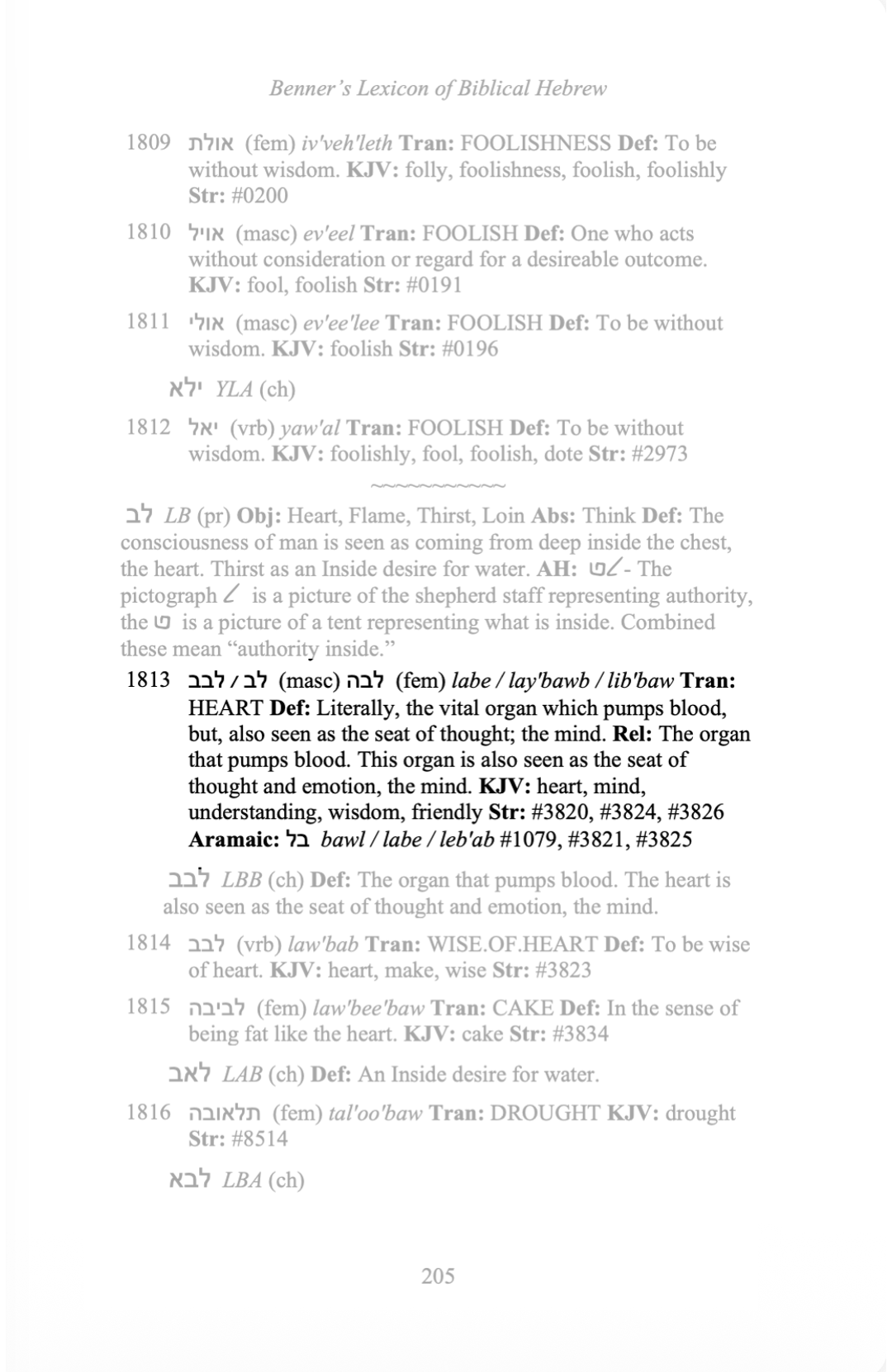
Next, let’s take a look at the word “heart” and how it is defined in my lexicon, Benner’s Lexicon of Biblical Hebrew.

לבב / לב (masc) לבה (fem) labe / lay'bawb / lib'baw Tran: HEART DEF: Literally, the vital organ which pumps blood, but also seen as the seat of thought; the mind. Rel: The organ that pumps blood. This organ is also seen as the seat of thought and emotion, the mind. KJV: heart, mind, understanding, wisdom, friendly Str: #3820, #3824, #3826 Aramaic: בל bawl / labe / leb'ab #1079, #3821, #3825
Note that the Hebrew word for “heart” is לב (lev) and in most cases, this Hebrew word is translated as "heart." However, this is not always the case and the following passage will demonstrate the need to examine the original language behind any translation.
…ye know the heart of a stranger… (Exodus 23:9, KJV)
Here is this phrase in my translations.
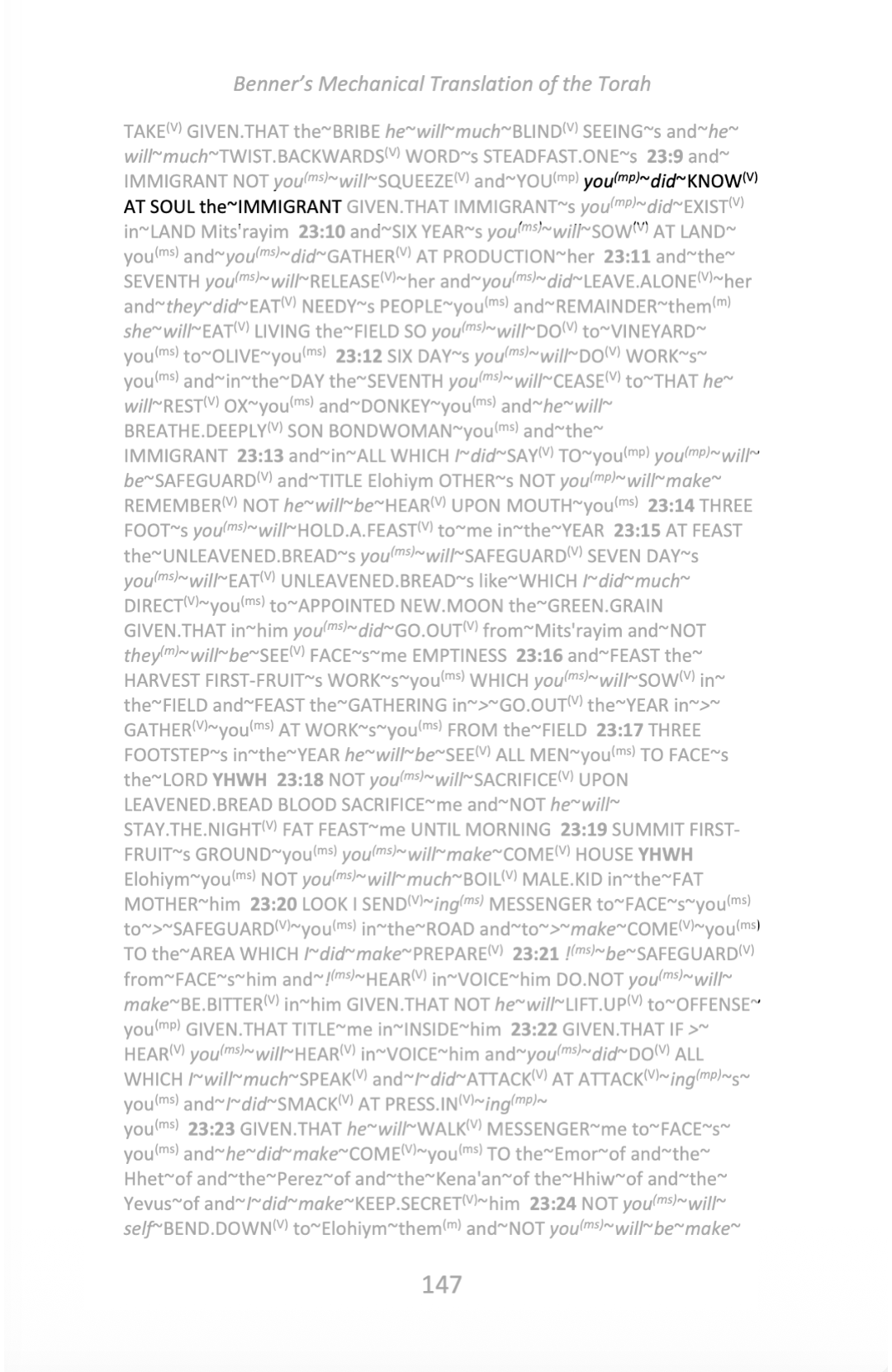
While the English translation uses the word “heart,” we can see through this translation that it is not the Hebrew word לב (lev), but the word נפש (nephesh).
Here is the entry for this Hebrew word in my lexicon.
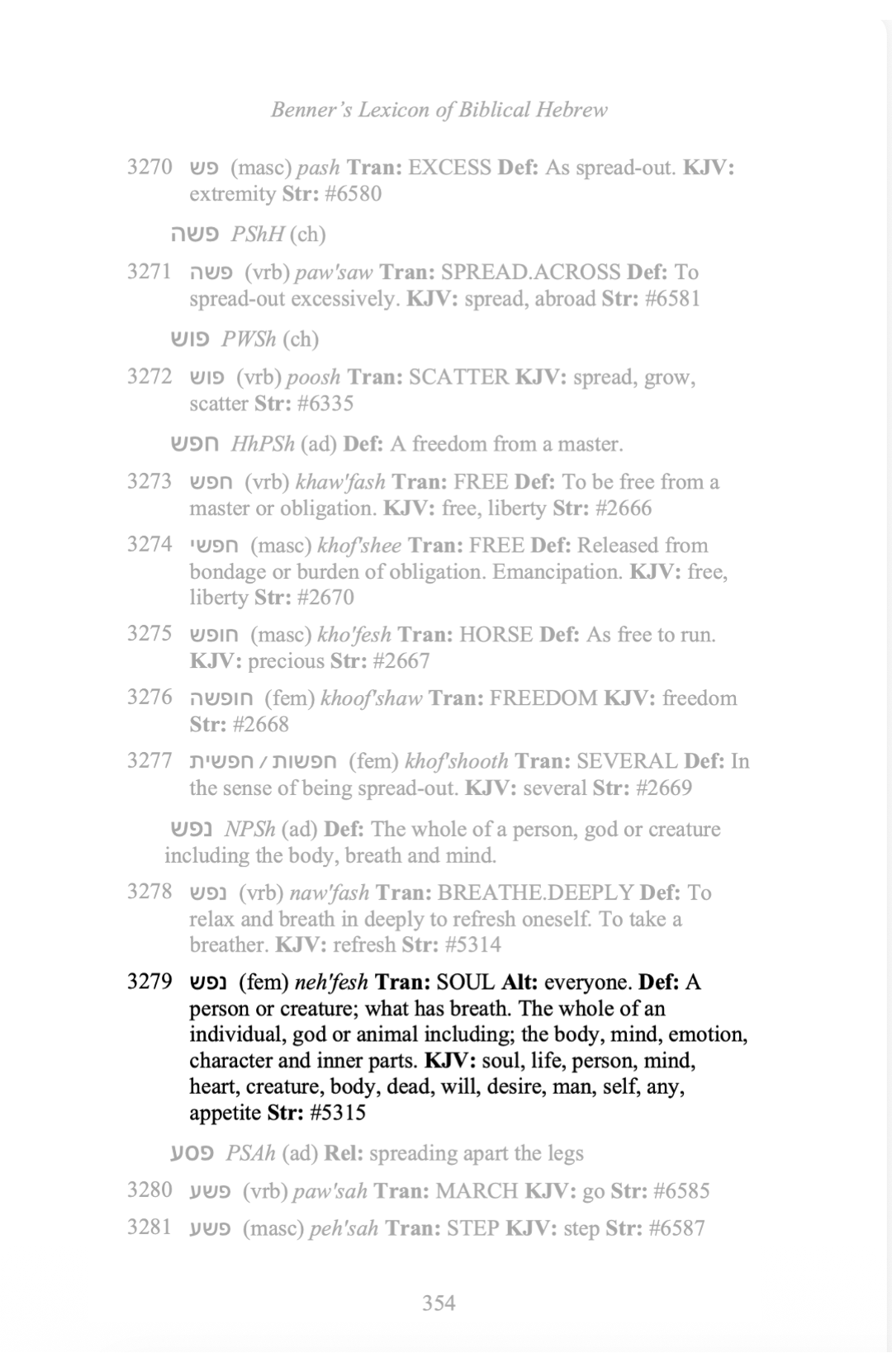
נפש (fem) neh'fesh Tran: SOUL Alt: everyone Def: A person or creature; what has breath. The whole of an individual, god or animal including; the body, mind, emotion, character and inner parts. KJV: soul, life, person, mind, heart, creature, body, dead, will, desire, man, self, any, appetite Str: #5315
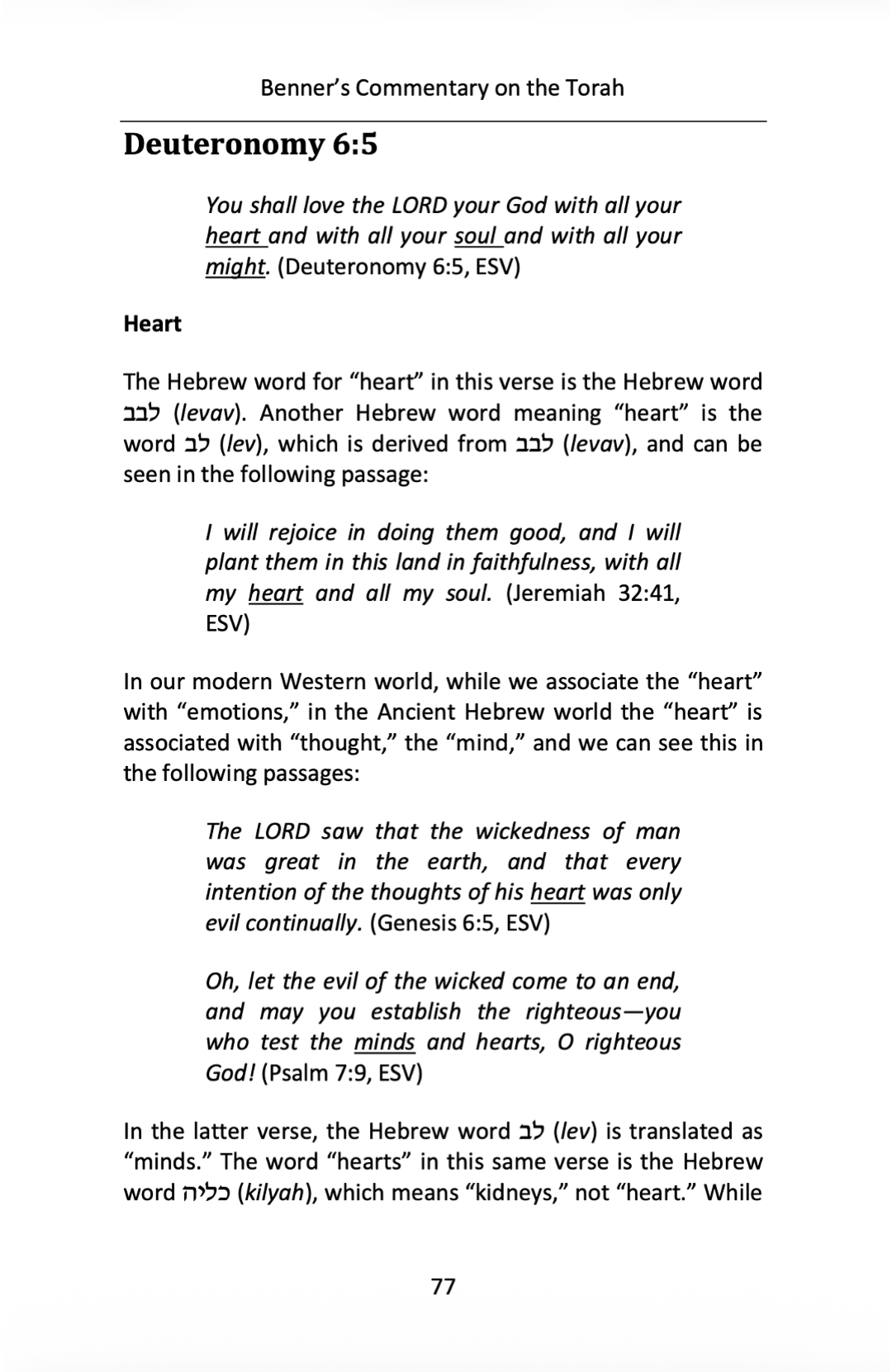
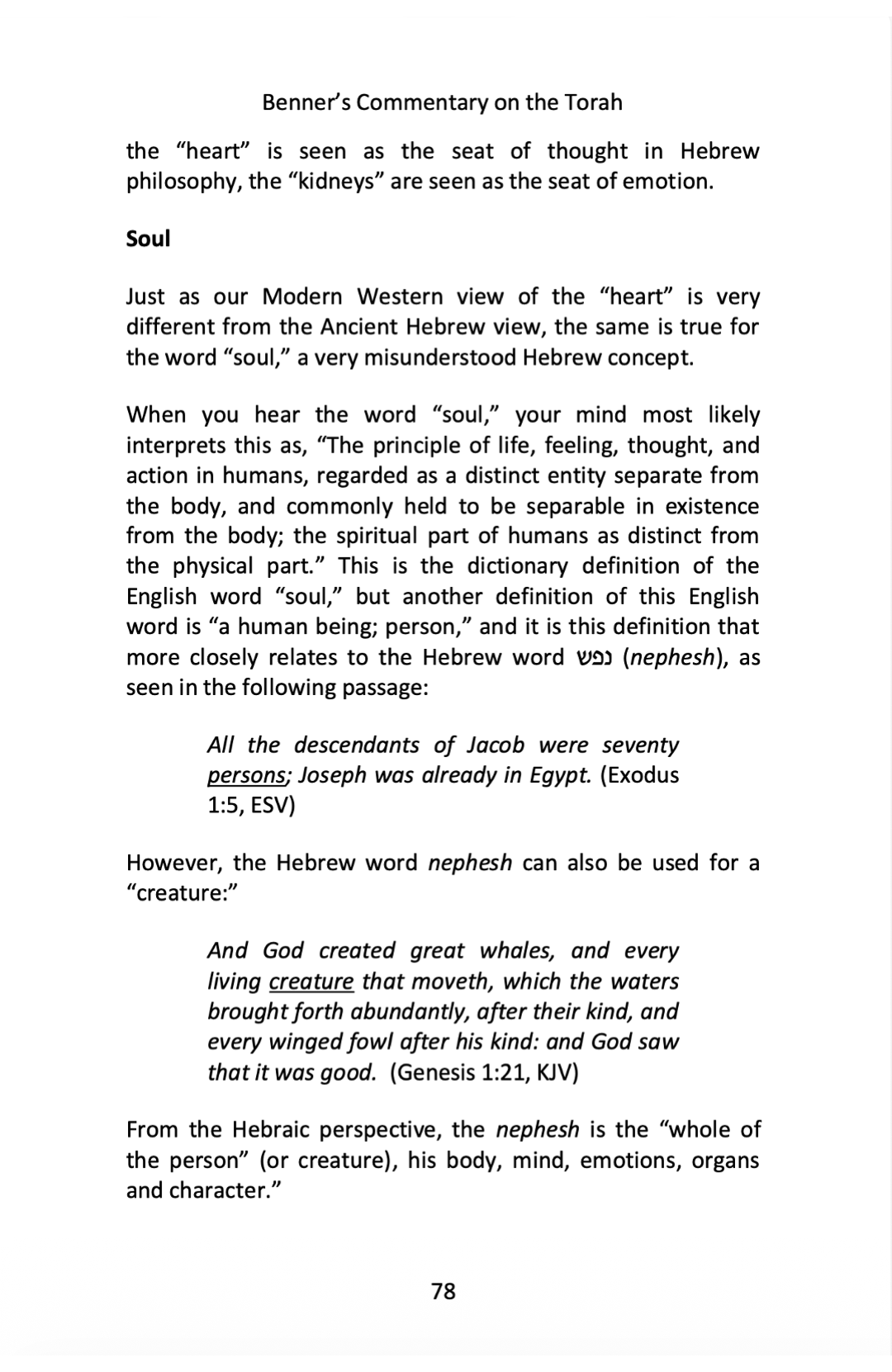
In order to truly understand the Hebrew words lev (heart) and nephesh (soul), both of which appear in Deuteronomy 6:5, let me share with you an excerpt from my book, Benner’s Commentary on the Torah.

The Hebrew word for “heart” in this verse is the Hebrew word לבב (levav). Another Hebrew word meaning “heart” is the word לב (lev), which is derived from לבב (levav), and can be seen in the following passage:
I will rejoice in doing them good, and I will plant them in this land in faithfulness, with all my heartand all my soul. (Jeremiah 32:41, ESV)
In our modern Western world, while we associate the “heart” with “emotions,” in the Ancient Hebrew world the “heart” is associated with “thought,” the “mind,” and we can see this in the following passages:
The LORD saw that the wickedness of man was great in the earth, and that every intention of the thoughts of his heart was only evil continually. (Genesis 6:5, ESV)
Oh, let the evil of the wicked come to an end, and may you establish the righteous—you who test the minds and hearts, O righteous God! (Psalm 7:9, ESV)
In the latter verse, the Hebrew word לב (lev) is translated as “minds.” The word “hearts” in this same verse is the Hebrew word כליה (kilyah), which means “kidneys,” not “heart.” While the “heart” is seen as the seat of thought in Hebrew philosophy, the “kidneys” are seen as the seat of emotion.
Just as our Modern Western view of the “heart” is very different from the Ancient Hebrew view, the same is true for the word “soul,” a very misunderstood Hebrew concept.
When you hear the word “soul,” your mind most likely interprets this as, “The principle of life, feeling, thought, and action in humans, regarded as a distinct entity separate from the body, and commonly held to be separable in existence from the body; the spiritual part of humans as distinct from the physical part.” This is the dictionary definition of the English word “soul,” but another definition of this English word is “a human being; person,” and it is this definition that more closely relates to the Hebrew word נפש (nephesh), as seen in the following passage:
All the descendants of Jacob were seventy persons; Joseph was already in Egypt. (Exodus 1:5, ESV)
However, the Hebrew word nephesh can also be used for a “creature:”
And God created great whales, and every living creature that moveth, which the waters brought forth abundantly, after their kind, and every winged fowl after his kind: and God saw that it was good. (Genesis 1:21, KJV)
From the Hebraic perspective, the nephesh is the “whole of the person” (or creature), his body, mind, emotions, organs and character.”
Let’s take a look at another verse using the word “heart.”
…test my heart and my mind. (Psalm 26:2, ESV)
If the heart is, as I have postulated, the mind, why do we see the mind alongside the word “heart?” We will find the answer in my translations.
In this verse, the translator chose to translate the Hebrew word kil’yah (kidneys) as “heart” and the word lev (heart) as “mind.” This is a case of the translators fixing the text for you. They recognize that we do not use the word kidneys in our language in this context, so they replace it with something more acceptable, erasing the original intent of the author.
As it turns out, it is the kidney’s that are the seat of emotion in Hebrew thought, just as the Christian Standard Bible shows in its translation of Psalm 7:9.
…examines the thoughts (lev/heart) and emotions (kil’yah/kidney)…
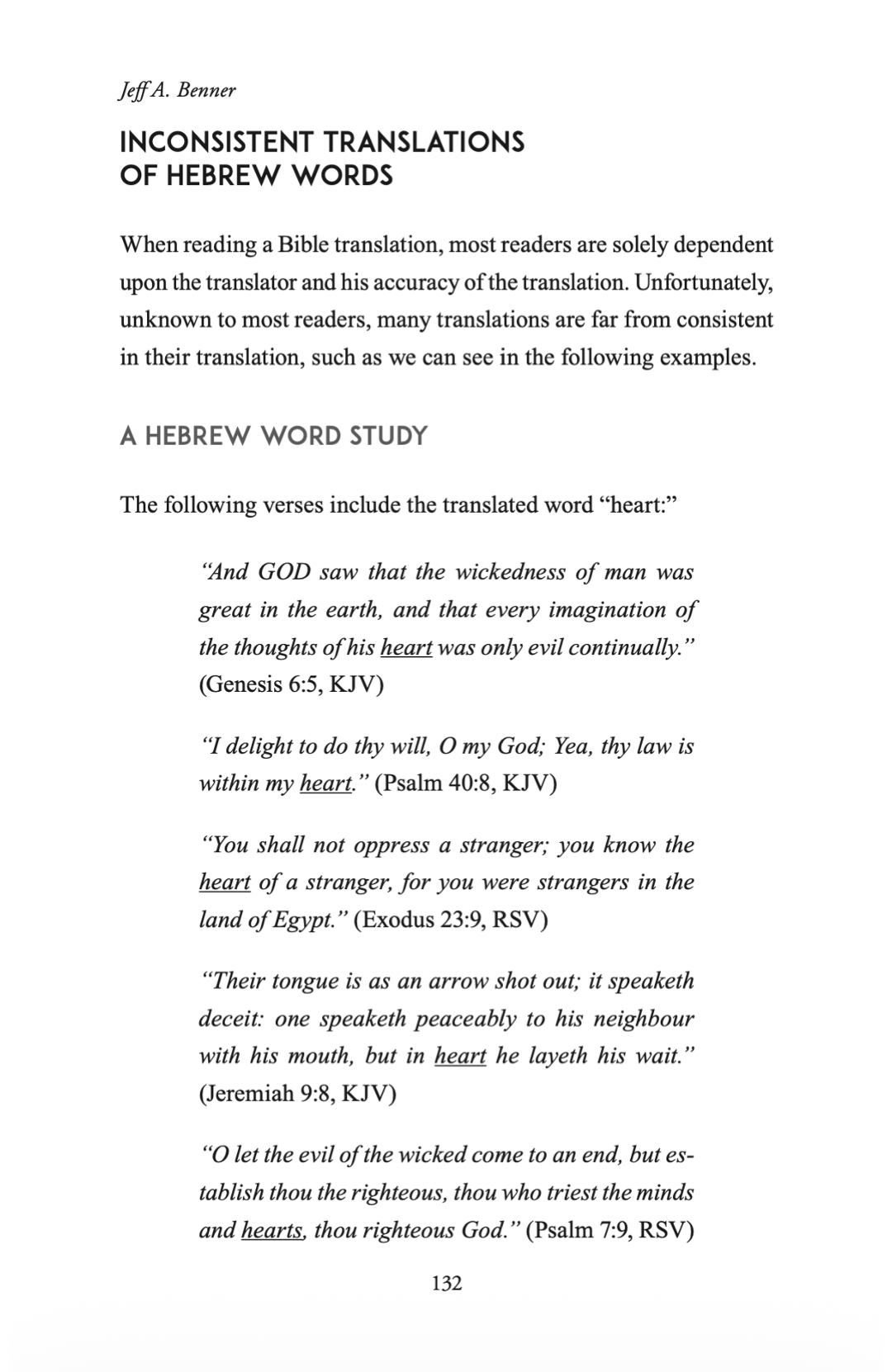
Below is my study on the word “heart” from my book, A Cultural and Linguistic Excavation.
When reading a Bible translation, most readers are solely dependent upon the translator and his accuracy of the translation. Unfortunately, unknown to most readers, many translations are far from consistent in their translation, such as we can see in the following examples.
The following verses include the translated word “heart:”
“And GOD saw that the wickedness of man was great in the earth, and that every imagination of the thoughts of his heart was only evil continually.” (Genesis 6:5, KJV)
“I delight to do thy will, O my God; Yea, thy law is within my heart.” (Psalm 40:8, KJV)
“You shall not oppress a stranger; you know the heart of a stranger, for you were strangers in the land of Egypt.” (Exodus 23:9, RSV)
“Their tongue is as an arrow shot out; it speaketh deceit: one speaketh peaceably to his neighbour with his mouth, but in heart he layeth his wait.” (Jeremiah 9:8, KJV)
“O let the evil of the wicked come to an end, but establish thou the righteous, thou who triest the minds and hearts, thou righteous God.” (Psalm 7:9, RSV)
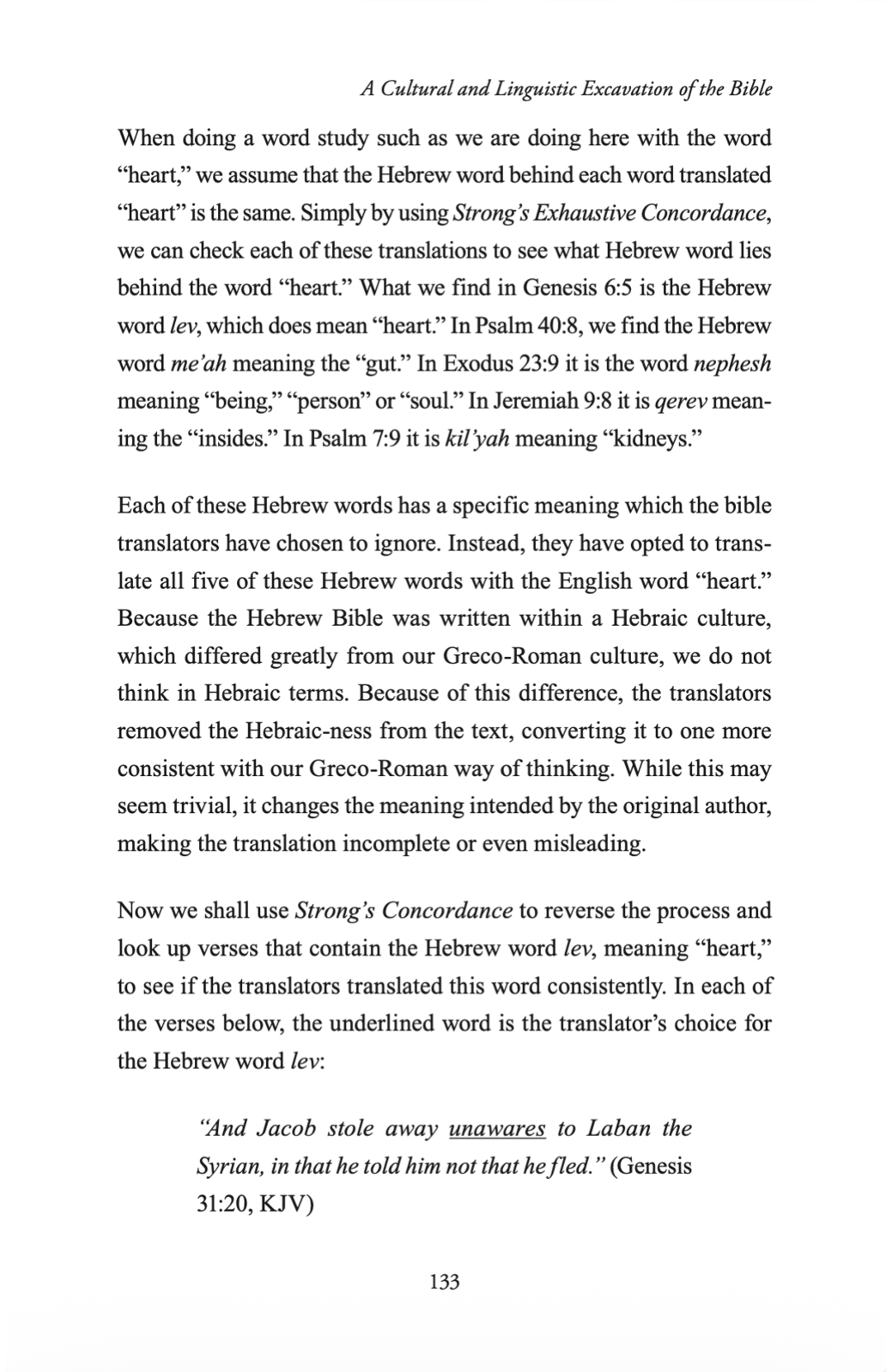
When doing a word study such as we are doing here with the word “heart,” we assume that the Hebrew word behind each word translated “heart” is the same. Simply by using Strong’s Exhaustive Concordance, we can check each of these translations to see what Hebrew word lies behind the word “heart.” What we find in Genesis 6:5 is the Hebrew word lev, which does mean “heart.” In Psalm 40:8, we find the Hebrew word me’ah meaning the “gut.” In Exodus 23:9 it is the word nephesh meaning “being,” “person” or “soul.” In Jeremiah 9:8 it is qerev meaning the “insides.” In Psalm 7:9 it is kil’yah meaning “kidneys.”
Each of these Hebrew words has a specific meaning which the bible translators have chosen to ignore. Instead, they have opted to translate all five of these Hebrew words with the English word “heart.” Because the Hebrew Bible was written within a Hebraic culture, which differed greatly from our Greco-Roman culture, we do not think in Hebraic terms. Because of this difference, the translators removed the Hebraic-ness from the text, converting it to one more consistent with our Greco-Roman way of thinking. While this may seem trivial, it changes the meaning intended by the original author, making the translation incomplete or even misleading.
Now we shall use Strong’s Concordance to reverse the process and look up verses that contain the Hebrew word lev, meaning “heart,” to see if the translators translated this word consistently. In each of the verses below, the underlined word is the translator’s choice for the Hebrew word lev:
“And Jacob stole away unawares to Laban the Syrian, in that he told him not that he fled.” (Genesis 31:20, KJV)
“And he that regarded not the word of Jehovah left his servants and his cattle in the field.” (Exodus 9:21, ASV)
“And Moses said, hereby ye shall know that Jehovah hath sent me to do all these works; for I have not done them of mine own mind.” (Numbers 16:28, ASV)
“Behold, God is mighty, and despiseth not any: He is mighty in strength of understanding.” (Job 36:5, ASV)
“For they have consulted together with one consent; against thee do they make a covenant:” (Psalm 83:5, ASV)
“He that getteth wisdom loveth his own soul: He that keepeth understanding shall find good.” (Proverbs 19:8, ASV)
Again, the translators ignored the original text, erased its original Hebraic-ness and replaced it with words that fit Greco-Roman thinking
Bible translators often shape their translations to fit a modern Western mindset. I believe, however, that translations and other biblical resources should do the opposite: they should help shape our minds to align with the ancient Eastern way of thinking held by the people of the Bible.
For a limited time
50% off